

From Beach to Board: A Step-by-Step Guide to Your Child’s First Surf Lesson in Tamarindo
Updated: Aug 24

Booking your child’s first surf lesson can feel exciting and a little emotional at the same time.
You want them to have fun and experience the thrill of catching their first wave, but as a parent, you’re probably also wondering what will actually happen once the lesson begins.
Will the instructor stay close to them?
Do they go straight into the ocean?
What happens if they feel nervous?
And how much surfing can a child realistically learn in one lesson?
A well-structured kids surf lesson should never feel rushed.
It should move step by step - from getting comfortable with the instructor and learning basic ocean safety on the beach to practicing on the board and eventually catching small, manageable waves in the water.
At Salty Smile Surf School in Tamarindo, we’ve found that children learn best when they understand what is happening next and feel supported throughout the experience.
This guide walks parents through a child’s first surf lesson in Tamarindo from beginning to end - so you know what to expect before you arrive at the beach.
Quick Answer: What Happens During a Child’s First Surf Lesson?
A child’s first surf lesson usually begins with meeting the instructor, getting the right equipment, warming up, and learning basic safety and surf technique on the beach. From there, the instructor takes the child into beginner-friendly water and helps them catch their first waves while staying close throughout the session.
The exact pace depends on the child.
Some kids are ready to try standing almost immediately, while others need more time to become comfortable with the board, the waves, or simply being in the ocean.
Both are progress.
Before the Lesson: Preparation and Comfort

A child’s first surf lesson begins before they ever step into the ocean.
When families arrive at Salty Smile Surf School, the first priority is helping the child feel comfortable with the instructor and the experience ahead.
Some kids arrive excited and ready to run straight into the water.
Others are quieter, cautious, or unsure about the waves.
Both reactions are completely normal.
Before heading to the beach, the instructor takes a few minutes to understand the child - their age, swimming ability, previous ocean experience, confidence level, and whether there is anything they feel nervous about.
The equipment is then matched to the child, including:
A beginner-friendly soft-top surfboard appropriate for their size
A properly fitted leash
A long-sleeve rash guard
Any adjustments needed based on their comfort and ability
The instructor also checks the ocean conditions before the lesson begins.
Wave size, tide, wind, and the area of the beach being used can all influence where the lesson takes place and how it is structured.
At Salty Smile Surf, we keep our standard at a maximum of two students per instructor, allowing the coach to stay closely involved and adapt the lesson to each child rather than moving an entire group at the same pace.
For a first-time child surfer, those few minutes of preparation matter.
The goal is for them to walk toward the beach knowing who their instructor is, what is going to happen next, and that they don’t need to prove anything.
Warm-Up: Getting Comfortable Before the Lesson
Before learning how to stand on the board, kids start with a short, simple warm-up on the beach.
This isn't an intense workout.
The goal is to get the body moving, help the child relax, and create an easy transition into the lesson.
The instructor may use:
- Gentle movements for the shoulders, arms, and legs
- Simple balance and coordination exercises
- Light, playful movements that keep younger children engaged
This is also another opportunity for the instructor to observe how the child moves, communicates, and responds to instructions.
For nervous first-time surfers, these few minutes can be especially valuable.
Instead of arriving at the beach and immediately being asked to perform something unfamiliar, the child gets time to settle into the experience.
Once they feel comfortable and ready, the lesson moves into one of its most important stages: learning about the ocean and practicing the basics on land.
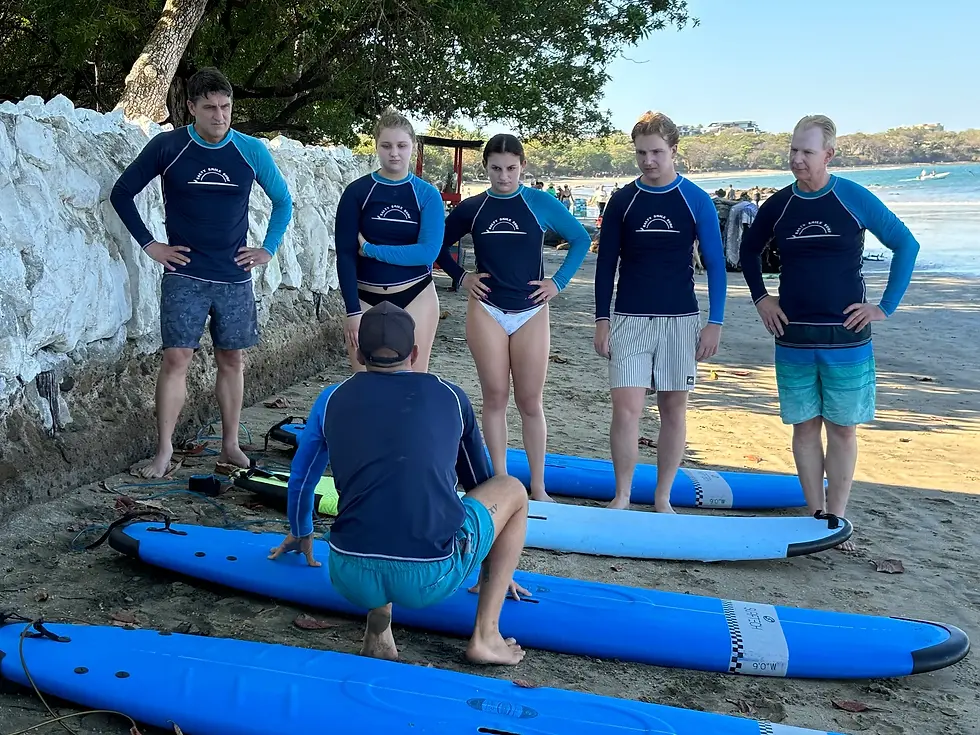
Beach Briefing: Learning the Basics Before Entering the Water

After the warm-up, the instructor introduces the child to the surfboard and explains the basics on the beach before anyone enters the ocean.
For a first-time surfer, keeping this part simple is important.
Kids don't need a long technical explanation - they need to understand a few clear things they can remember once they're in the water.
The instructor explains and practices:
- How to lie in the correct position on the surfboard
- Where to place their hands
- How to move from lying down to standing up
- The basic stance and balance position
- How to fall away from the board safely
- What to do when the instructor gives them directions in the water
Kids also receive a simple introduction to the ocean: where the waves are coming from, where the lesson will take place, and why the instructor may choose one wave and let another one pass.
Then comes the fun part - practicing the pop-up on the sand.
The instructor can adjust the movement to the child's age, coordination, and confidence. There is no expectation that every child performs it perfectly before entering the water. The beach practice simply gives them a familiar movement to return to once they begin catching waves.
Parents are welcome to stay nearby, watch the briefing, and ask questions before the water portion begins.
This guide focuses on what happens during your child's first surf lesson, step by step.
For a deeper look at the safety framework behind kids surf lessons - including equipment, supervision, ocean conditions, and instructor setup.
In the Water: From the First Whitewater Wave to Standing Up
Once the beach practice is finished, it's time to enter the water.
For a child's first surf lesson, the session begins in beginner-friendly waves where the instructor can stay close and guide the child through each attempt.
At first, the instructor helps with the things a beginner doesn't yet know how to manage alone - positioning the board, choosing an appropriate wave, timing the start, and helping the child get moving with the wave.
The first goal doesn't have to be standing up.
Some children begin by riding a wave lying on the board so they can experience what it feels like when the wave carries them toward the beach.
From there, they may try getting onto their knees, practicing the movement they learned on the sand, or going directly for their first pop-up.
As the child becomes more comfortable, the instructor can gradually give them more responsibility.
Instead of simply being placed onto every wave, they begin to understand when a wave is coming, how to position themselves, when to start moving, and when to stand.
Some children stand on their first few attempts.
Others need more time - and that's completely normal.
A successful first session isn't about how quickly a child stands up.
It's about helping them understand the process, enjoy their first waves, and finish the lesson feeling more comfortable in the ocean than when they started.
Learning at the Child's Pace
Once a child starts catching waves, the instructor begins watching for something just as important as technique: how the child is responding to the experience.
Are they excited to try again?
Are they listening and understanding the instructions?
Are they becoming more comfortable with each wave, or starting to feel tired or overwhelmed?
These small signals help the instructor decide what should happen next.
A confident child may be ready to work on their pop-up, stance, balance, and timing. Another child may benefit from staying with smaller waves, repeating the same movement several times, or simply spending more time getting comfortable on the board.
The lesson can also change as it progresses.
If something is working, the instructor can build on it. If a child becomes nervous or frustrated, the pace can slow down and the focus can return to something that already feels familiar.
This is why progress in a child's first surf lesson shouldn't be measured only by whether they stand up.
Learning how the board feels, understanding basic instructions, becoming more comfortable around waves, and wanting to try again are all meaningful parts of learning to surf.
The goal of the first lesson is to create a foundation the child can build on - not to rush them through a checklist of surfing skills.
What Parents Should Bring to a Kids Surf Lesson

You don't need to arrive with surf equipment of your own.
At Salty Smile Surf, we provide the equipment your child needs for the lesson, including:
- A beginner-friendly soft-top surfboard
- A leash
- A long-sleeve rash guard
Parents only need to bring a few personal items:
- Reef-safe sunscreen, applied before the lesson
- A towel
- Dry clothes for afterward
- A reusable water bottle
- A phone or camera if you'd like to capture the experience
It's also a good idea for your child to arrive hydrated, having eaten appropriately beforehand, and with enough time that no one feels rushed.
If your child has anything we should know before the lesson - for example, they're nervous around waves or this will be their first real experience in the ocean - tell us before the session begins.
Those small details can help the instructor understand how to approach the first few minutes of the lesson.
The Parent's Role During the First Surf Lesson
Parents often ask, “Where should I be while my child is surfing?”
You're always welcome to watch from the beach, stay closer to the water, and take photos or videos of the experience.
But one of the most helpful things a parent can do is give the child and instructor enough space to build their own connection.
Some children look back toward their parents after every wave. Others become completely focused on their instructor and forget anyone else is watching.
Both reactions are normal.
If your child is comfortable and engaged, allowing the instructor to lead the lesson can help them listen, make decisions, and gradually build confidence on their own.
If they become nervous or need reassurance, the instructor can slow things down, and having a familiar parent nearby can sometimes help.
There's no single rule for how close a parent should be.
The goal is to find the balance that works for your child - being available when they need you while also giving them room to experience something new for themselves.
And don't worry if the first lesson doesn't look exactly how you imagined it.
Sometimes the moment parents remember most isn't the first time their child stands up - it's the moment they stop looking back toward the beach and start asking their instructor for one more wave.
Want to experience the water alongside your kids instead of only watching from the beach?
Why Tamarindo Works Well for a Child's First Surf Lesson
Tamarindo is a popular place for beginners to learn to surf, and many families choose it for their children's first experience in the water.
One reason is that the main beach has a sandy bottom and offers access to smaller whitewater waves that can work well for first-time surfers when conditions are appropriate.
The warm water also means children can focus on learning without needing a wetsuit in typical conditions.
But beginner-friendly doesn't mean every part of the beach is equally suitable at every time of day.
Tides, swell size, wind, currents, and crowds can change the conditions significantly. That's why we don't choose where and how a child learns based only on the fact that they're in Tamarindo.
Before each lesson, the instructor looks at the conditions that day and chooses the area and type of waves that best match the child's age, confidence, and ability.
For a first surf lesson, we're not searching for the biggest or most exciting waves.
We're looking for conditions that give the child the best opportunity to understand the basics, catch manageable waves, and build confidence gradually.
That's what can make Tamarindo a great place to learn to surf - not that the ocean is always easy, but that experienced local instructors can work with its changing conditions to find an appropriate setup for beginners.
Planning your own first surf session too?
After the Water: What Happens at the End of the First Lesson?

When the water portion of the lesson ends, the learning doesn't simply stop at the shoreline.
This is a good moment for the instructor to talk with the child and parents about how the session went - what felt comfortable, what the child learned, what they enjoyed most, and what they could work on next time.
For one child, the biggest achievement might be standing up and riding several waves.
For another, it might be learning how to position themselves on the board, completing their first pop-up, becoming comfortable in the whitewater, or simply finishing the lesson excited to surf again.
All of those can be meaningful progress.
A first surf lesson gives children an introduction to the board, the waves, basic technique, and the feeling of moving through the water. It also gives the instructor a much better understanding of how that particular child learns.
If the child continues with additional lessons, the focus can gradually shift from simply catching waves with close assistance toward better timing, balance, positioning, ocean awareness, and eventually greater independence.
But there is no need to rush that progression.
For a child's first experience, one of the best outcomes is surprisingly simple: they leave the water proud of what they tried and excited about the possibility of doing it again.
How Long Is a Child’s First Surf Lesson?
At Salty Smile Surf, a first surf lesson is approximately two hours from start to finish.
That time includes the full experience - getting ready, warming up, learning the basics and safety on the beach, practicing the pop-up, and surfing in the water.
We don't divide every lesson into a fixed number of minutes for each stage.
A child who understands the beach practice quickly may be ready to enter the water sooner, while another child may benefit from a little more time getting comfortable with the instructor, the board, or the idea of going into the waves.
The same flexibility continues in the water.
The lesson moves according to the child's age, confidence, energy, and progress rather than rushing through each stage to follow a strict timetable.
For first-time surfers, that gives us enough time to teach the foundations properly while still leaving plenty of opportunity to catch waves and enjoy the experience.
Coach's Insight from Bobby
After years of teaching children in Tamarindo, Bobby, our head surf coach at Salty Smile Surf, has learned that the first few waves often tell you much more than whether a child can stand up.
Some kids need very little encouragement and immediately want to try again.
Others need time to understand the board, feel the movement of the wave, and build trust with their instructor.
For Bobby, the goal isn't to make every child's first lesson look the same.
It's to understand what that particular child needs to leave the water feeling more confident than when they entered.
Ready for Your Child's First Surf Lesson in Tamarindo?
If you're planning your child's first surf lesson, you don't need to know exactly which lesson setup will work best before you contact us.
Tell us your child's age, whether they've surfed before, how comfortable they are in the ocean, and anything you're unsure or concerned about.
We'll help you choose the right lesson setup and, when the day arrives, our instructors will adapt the experience to your child and the conditions in the water.
At Salty Smile Surf, our kids surf lessons are designed to give first-time surfers personal attention, clear instruction, and the time they need to learn without being rushed.
We'd love to be there for their first wave.
🌊 Keep your smile salty.


Comments