

Private vs Group Surf Lessons for Kids: What Parents Should Know Before Booking
Updated: Aug 27

Choosing between private and group surf lessons for kids isn't simply a question of which option is “better.”
The right lesson format depends on the child.
A first-time surfer who feels nervous in the ocean may benefit from a very different setup than two siblings who are excited to learn together.
An outgoing child may love sharing the experience with other kids, while another may learn better with more individual attention and fewer distractions.
There is also an important detail parents should understand before comparing lesson options:
“Group lesson” doesn't mean the same thing at every surf school.
The number of children assigned to each instructor can make a significant difference in how much individual coaching each child actually receives.
This guide explains the differences between private, semi-private, and group surf lessons for kids, what parents should compare before booking, and how to choose the format that best fits your child's confidence, experience, and learning style.
Quick Answer: Are Private or Group Surf Lessons Better for Kids?
Neither format is automatically better for every child.
Private surf lessons can be a good fit for children who benefit from one-on-one attention, want to progress at their own pace, or need extra time to become comfortable in the ocean.
Semi-private lessons can work especially well for siblings, friends, or a parent and child who want to learn together while still receiving close instructor attention.
Group lessons can create a fun, social experience, but parents should always ask how many students are assigned to each instructor rather than judging the lesson by the word “group” alone.
The best choice depends on your child's age, ocean confidence, previous experience, personality, and how much individual coaching they need.

Why Lesson Format Matters for Kids
Children don't all need the same kind of surf lesson.
Some kids learn best when they have an instructor completely to themselves.
Others relax more when they're learning beside a sibling, friend, or parent.
Some enjoy the energy of a larger family or group experience but still need enough instructor support to receive individual coaching.
That's why lesson format is about more than the number of people in the water.
It affects how often an instructor can give feedback, how easily the pace can be adjusted, how much waiting there is between attempts, and how independently each child is expected to participate.
For younger children, nervous first-time surfers, or kids who need more reassurance, a more individual setup can make it easier for the instructor to slow down and respond to the child moment by moment.
For siblings or friends who are comfortable learning together, sharing an instructor can make the experience social and fun without necessarily giving up close coaching - as long as the instructor-to-student ratio remains small.
The goal is to match the lesson structure to the child rather than expecting the child to fit a predetermined format.
First, Understand the Instructor-to-Student Ratio
Before comparing private and group surf lessons, parents should understand one number that can matter more than the name of the lesson itself:
The instructor-to-student ratio.
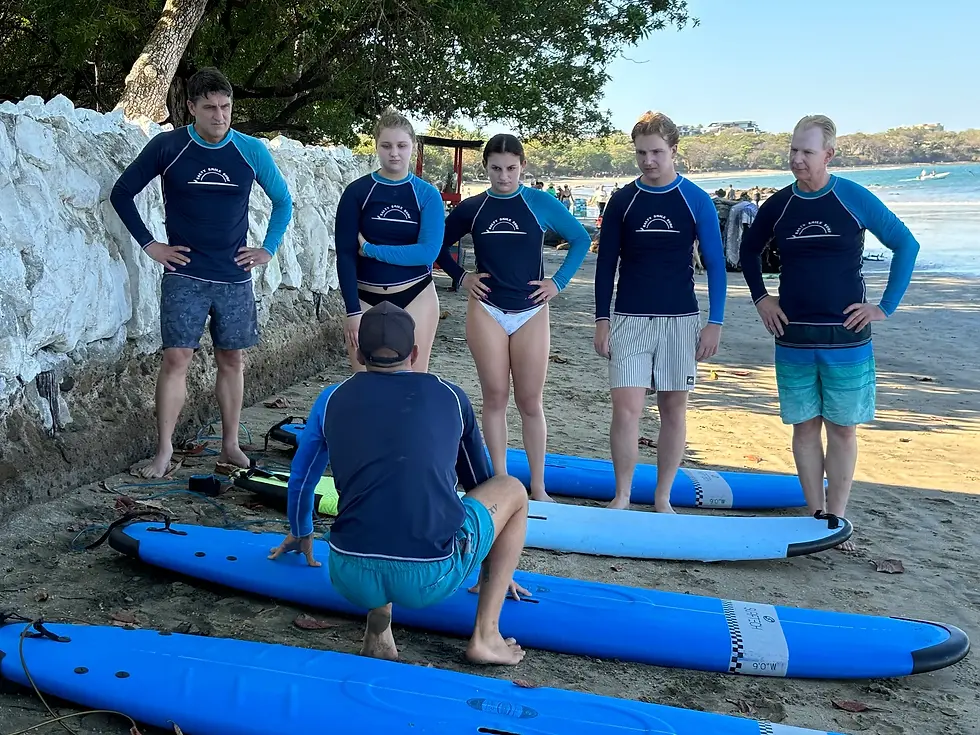
A “group lesson” could mean several surfers sharing one instructor, or it could mean a larger family or group supported by multiple instructors.
Those are very different learning setups.
At Salty Smile Surf, our standard is a maximum of two students per instructor.
If a family or group books together, we add instructors according to the number of surfers rather than placing the entire group with a single coach.
This allows families and friends to share the experience while still keeping the individual coaching that beginner surfers need.
So when comparing kids surf lesson options, don't ask only:
“Is this private or group?”
Also ask:
“How many students will actually be assigned to each instructor?”

Private Surf Lessons for Kids: When Does 1:1 Make Sense?
A private kids surf lesson means one child learns with one dedicated instructor.
The biggest advantage of a 1:1 lesson isn't simply having the instructor nearby. It's the ability to build the entire session around one child.
The instructor can adjust the pace, choose waves for that child's ability, give feedback after each attempt, repeat a skill when needed, and move forward when the child is ready.
A private lesson may be especially useful when:
- It's the child's first time surfing and they feel nervous about the ocean
- The child benefits from extra reassurance or individual attention
- They are younger and need closer guidance
- They learn better without the distraction of other students
- They have already surfed before and want more focused coaching
- Their ability or confidence level is very different from the other family members surfing
But private doesn't automatically mean better.
A confident child who loves learning alongside a sibling or friend may enjoy a shared lesson just as much - and can still receive plenty of individual coaching when the instructor-to-student ratio is kept small.
The question isn't whether 1:1 is the “best” format.
It's whether your child will benefit from having the instructor completely to themselves.
If this will be your child's first time surfing, our step-by-step guide to a child's first surf lesson in Tamarindo explains what happens from the beach briefing to their first waves in the water.
Semi-Private Surf Lessons for Kids: When Learning Together Works Best
A semi-private surf lesson means two surfers learning together with one instructor.
For many families, this can be an ideal balance between individual attention and the fun of sharing the experience.
Semi-private lessons can work especially well for:
- Two siblings who want to learn together
- Two friends at a similar level
- A parent and child who want to surf together
- Children who feel more comfortable entering the ocean with someone they know
- Kids who enjoy learning socially but still benefit from close instructor attention
With only two students sharing one instructor, each surfer can still receive individual feedback, wave selection, and support throughout the lesson.
The two surfers don't need to progress at exactly the same pace.
A good instructor can adjust the level of assistance, feedback, and waves for each child individually while they continue sharing the experience.
At Salty Smile Surf, our standard maximum ratio is two students per instructor. That means a semi-private lesson keeps the experience personal while allowing siblings, friends, or family members to learn together.
For many families, it's the sweet spot between one-on-one coaching and a shared surf experience.

Safety Comparison: Private vs Group Lessons
When comparing private and group surf lessons for kids, safety shouldn't be judged by the lesson name alone.
What matters more is how much supervision each child actually receives.
In a private 1:1 lesson, the instructor can focus entirely on one child - staying close, selecting appropriate waves, adjusting the pace, and responding immediately if the child becomes tired, nervous, or unsure.
In a semi-private lesson, two surfers share one instructor.
This can still provide close supervision while allowing siblings, friends, or family members to enjoy learning together.
For larger families or groups, the key question is the instructor-to-student ratio.
A group of six children supported by three instructors is very different from six children sharing one instructor.
At Salty Smile Surf, we maintain a maximum ratio of two students per instructor, including when larger families or groups book together.
This is why parents comparing surf lessons for kids in Tamarindo should look beyond labels like “private” or “group” and ask how many children each instructor will actually be responsible for in the water.
Lesson format is only one part of kids surf safety.
Ocean conditions, equipment, instructor experience, beach selection, and lesson structure matter too.
For a complete explanation of those factors, read our Kids Surf Safety Guide.
Progress and Confidence: What Helps Kids Learn Faster?
Progress in surfing looks different for every child.
For one child, progress may mean standing up on the first few waves.
For another, it may mean becoming comfortable in the ocean, learning how to control the board, or gaining enough confidence to try again after falling.
The lesson format can support that progress in different ways.
In a private lesson, the instructor can focus entirely on one child, adjust the pace after every attempt, and spend more time on the specific skills that need attention.
In a semi-private lesson, children can still receive individual feedback while also learning alongside a sibling, friend, or parent.
For some kids, having someone familiar beside them actually helps them relax and learn more confidently.
In a larger family or group lesson, children can enjoy the motivation and energy of learning together - as long as there are enough instructors to maintain close individual coaching.
At Salty Smile Surf, we don't measure a successful kids surf lesson only by how quickly a child stands up.
Confidence, ocean awareness, board control, independence, and simply wanting to catch another wave are all meaningful signs of progress.
The format that helps a child learn best is the one that gives them the right balance of attention, challenge, and enjoyment.
How to Choose the Right Surf Lesson for Your Child
Parents usually have the best sense of how their child responds to new experiences, and a few simple questions can make choosing the right lesson format much easier.
A private 1:1 lesson may be the better fit if your child:
- Feels nervous or hesitant around the ocean
- Needs extra reassurance or individual attention
- Learns better with fewer distractions
- Has a very different ability level from the other surfers in your family
- Would benefit from a lesson built entirely around their own pace
A semi-private lesson may be a great fit if your child:
- Wants to surf with a sibling, friend, or parent
- Feels more confident trying something new with someone familiar
- Enjoys learning socially
- Is comfortable sharing an instructor while still receiving individual coaching
For families or larger groups, learning together can also work well.
The important thing is to ask how many students are assigned to each instructor and make sure each child will still receive the attention they need.
If you're still unsure, tell the surf school your child's age, swimming ability, previous surf experience, and how comfortable they are in the ocean.
A good surf school should help you choose the lesson format based on the child rather than simply recommending the most expensive option.
Price is only one part of that decision.
Our guide to the real value of kids surf lessons in Tamarindo explains what parents should compare beyond the lesson price itself.
Why Tamarindo Works Well for Different Kids Surf Lesson Formats
One advantage of learning to surf in Tamarindo is that families don't all need to approach the experience in the same way.
Depending on the child and the conditions that day, lessons can be structured as private 1:1 coaching, semi-private instruction for two surfers, or a larger family or group experience supported by multiple instructors.
For families traveling together, this flexibility can be especially useful.
One child may want more individual support while a sibling is comfortable sharing an instructor.
A parent may want to learn alongside a child.
A family of four may want to experience the lesson together without placing all four surfers with a single coach.
Tamarindo's sandy beach, accessible shoreline, and variety of beginner-friendly areas give instructors options when choosing where to work with different surfers.
But the location alone doesn't determine the right lesson format.
The child's confidence, experience, age, the ocean conditions that day, and the instructor-to-student ratio should all be considered when deciding how the lesson is structured.
At Salty Smile Surf, we use those factors to help families choose a setup that makes sense for the people actually getting in the water.
What About Families or Larger Groups?
A family or group doesn't have to choose between surfing together and receiving individual attention.
The important distinction is between the size of the booking and the number of surfers assigned to each instructor.
For example, a family of four can take a surf lesson together while being supported by two instructors. The family still shares the experience, but each instructor is responsible for no more than two surfers.
The same principle can be applied to larger groups by adding instructors according to the number of students.
This can be especially helpful when families include:
- Several siblings who want to surf together
- Parents and children learning at the same time
- Children of different ages or confidence levels
- A mix of first-time surfers and family members with previous experience
The instructors can stay connected as a team while adjusting the coaching, wave selection, and level of assistance for the surfers they're responsible for.
At Salty Smile Surf, this is how we approach larger family and group bookings: we keep the shared experience while maintaining our standard maximum ratio of two students per instructor.
So a “group lesson” doesn't necessarily mean less personal attention.
What matters is how the group is structured once everyone enters the water.
Bobby's Perspective: Don't Choose by the Label
After years of teaching families in Tamarindo, Bobby has found that “private” or “group” tells only part of the story.
What matters more is who is actually in the water.
Two siblings may be perfect together. Another child may need an instructor completely to themselves. A family may want to surf as one group while still needing several instructors because of different ages, confidence levels, or experience.
That's why we prefer to understand the family first and recommend the lesson structure second.

“We came with our three kids for a few days to Tamarindo, and the surf lessons with Bobby and Juan turned our stay here into an unforgettable experience. Highly recommended!” - Carmit Feliks, ★★★★★ Google Review
Final Thoughts: Choose the Setup, Not Just the Label
There is no single lesson format that is right for every child.
For some kids, a private 1:1 lesson provides the individual attention they need to feel comfortable and progress at their own pace. For others, learning alongside a sibling, friend, or parent can make the experience more relaxed, social, and fun.
The most important thing is not whether a lesson is called “private” or “group.” It is how the lesson is structured, how many students each instructor is responsible for, and whether the setup matches your child’s confidence, experience, and personality.
At Salty Smile Surf School in Tamarindo, we help families choose a lesson setup that keeps the coaching personal while making sense for the people actually getting in the water.
If you're not sure which option is right for your child, tell us a little about their age, swimming ability, previous surf experience, and comfort in the ocean. We'll help you choose the right place to start.
Ready to plan your child's surf experience in Tamarindo?
We build surf skills.
We build family memories.
Keep your smile salty.


Comments