

The Stress-Free Family Surf Guide: How to Plan the Perfect Surf Vacation in Tamarindo
Updated: 4 days ago

Planning a family surf vacation in Tamarindo can be one of the highlights of a Costa Rica trip - but for parents, it often comes with a few important questions.
Will my child feel safe in the ocean?
Will the lesson match their age and confidence level?
Should we surf every day, or leave time to rest and explore?
And how do we make surfing something the whole family enjoys rather than another activity packed into the schedule?
After years of teaching families in Tamarindo, we've learned that the best family surf trips aren't built around chasing perfect waves or filling every day with activities.
They're built around the right conditions, personal instruction, realistic expectations, and enough flexibility for each child to progress at their own pace.
At Salty Smile Surf School, we work with families from complete beginners to parents and children who already have some surfing experience.
Lessons are organized around the family's level, the ocean conditions, and the best learning window that day.
This guide brings together what we've learned from teaching families in Tamarindo - from choosing the right lesson structure and planning your days around the ocean, to keeping kids comfortable, rested, and excited to get back in the water.

What Makes a Family Surf Vacation Feel Stressful?
For most parents, the stress starts before anyone gets on a surfboard.
You may be wondering whether the waves will be too big, whether your child will feel comfortable with the instructor, or what happens if one child is excited to surf and another suddenly doesn't want to go in the water.
Then there are the practical questions: What time should we book?
How many lessons should we plan?
Should parents surf too?
And how much else should we fit into the same day?
The biggest mistake is trying to control all of those variables in advance.
Ocean conditions change, children have different energy levels, and confidence can look completely different from one child to another - even within the same family.
A less stressful approach is to build some flexibility into the trip:
- Plan surf lessons around suitable ocean conditions rather than forcing the same time every day.
- Leave enough space between surfing and other activities for kids to rest.
- Tell the instructor honestly about each child's swimming ability, ocean experience, fears, or previous surf experience.
- Avoid comparing siblings or expecting them to progress at the same pace.
- Let the first session show you how your child responds before deciding what the rest of the surf week should look like.
For younger or nervous children, a successful first lesson might simply mean feeling comfortable with the instructor, playing in the waves, and wanting to try again.
For another child, it might mean standing up and riding their first wave.
Both can be successful beginnings.
If ocean safety is one of your biggest questions before booking, our Kids Surf Safety Guide explains what parents should consider before their child enters the water.
Why Is Tamarindo a Good Place for a Family Surf Vacation?
Tamarindo works well for many families because it combines access to beginner-friendly surf with the practical things that make traveling with children easier.
The main beach has sandy-bottom learning areas, warm water throughout the year, and different sections that instructors can use depending on the tide, swell, and conditions that day.
Tamarindo Bay is also more protected from direct swell than some of the more exposed surf breaks nearby.
Isla Capitán, located offshore, helps reduce some incoming swell, which can contribute to gentler waves inside the bay when conditions are suitable.
For children and first-time surfers, that can make a meaningful difference.
Instead of beginning at a more demanding surf break, kids can learn the fundamentals in conditions selected for their age, confidence, and experience.
But Tamarindo isn't automatically calm every day.
Wave size, currents, wind, tide, and crowds can all change.
That's why choosing the right part of the beach and the right time for a lesson matters more than simply saying that Tamarindo is “safe” or “easy.”
There is also a practical advantage for families: the beach, restaurants, shops, accommodations, and other activities are all close together.
That makes it possible to build surfing into a family vacation without making the entire trip revolve around surfing.

How Should You Plan a Family Surf Day in Tamarindo?
One of the easiest ways to make a family surf vacation stressful is to plan every day before you know when the best surf conditions will be.
A better approach is to let the surf lesson become the anchor of the day - and keep the rest of the schedule flexible around it.
Start With the Best Surf Window
There isn't one lesson time that is automatically best for every family or every day.
Tide, swell, wind, wave size, and your family's experience can all affect when and where a lesson should take place.
At Salty Smile Surf, we look at the conditions and recommend lesson times based on the surfers in the booking.
A family with young first-time surfers may need a different window from a family with teenagers who already have some experience.
That means your lesson might be in the morning, around midday, or later in the afternoon.
Leave Space Before and After Surfing
Surfing can take more energy than children expect, especially during their first few sessions.
Try not to schedule another demanding activity immediately before or after the lesson.
A relaxed meal, some pool time, a walk through town, or simply going back to the hotel to rest can give kids time to recharge without making the day feel empty.
Don't Try to Surf Every Free Hour
More water time isn't automatically better.
Some children want to surf again immediately.
Others are physically tired after one lesson, even if they loved it.
If you're staying for several days, watch how your children respond before deciding how much surfing to add to the trip.
Keep the Rest of the Vacation Flexible
Tamarindo makes this relatively easy because families can combine surfing with beach time, restaurants, wildlife, and other activities without traveling far between everything.
The goal isn't to build a perfect hourly schedule.
It's to create enough structure for the family to know what's happening, while leaving enough flexibility to adapt to the ocean - and to your kids.

Does Age Matter When Kids Learn to Surf?
Yes - age matters, but it doesn't tell the whole story.
Two children of the same age can have completely different experiences in their first surf lesson.
One may already be a confident swimmer who spends a lot of time in the ocean. Another may be comfortable in a pool but nervous around waves. A younger child may be eager to try everything, while an older child may need more time to understand the ocean before feeling comfortable.
That's why we look at more than age when teaching kids to surf.
Younger Children: Comfort and Trust Come First
With younger children, the first goal is often simply to create a positive relationship with the ocean, the surfboard, and the instructor.
That might mean practicing on the beach, playing in shallow water, riding waves with close instructor support, or standing up if the child is ready.
A successful lesson doesn't have to be measured by how many waves they ride.
If a child finishes the session smiling, feels comfortable with the instructor, and wants to surf again, that's meaningful progress.
School-Age Kids: Confidence Can Grow Quickly
As children become more physically coordinated and comfortable following instructions, they may begin putting the different parts of surfing together more easily.
They can start understanding positioning, timing, the pop-up, balance, and what the instructor is asking them to change from one wave to the next.
But there is still no fixed timeline.
Some kids stand during their first attempts. Others need more time to feel comfortable before technique starts to click.
Older Kids and Teens: More Technique, More Independence
Older children and teenagers may be ready for more detailed coaching around paddling, positioning, wave selection, stance, and eventually catching waves with less assistance.
They may also be more aware of making mistakes or comparing themselves with others.
Good coaching should account for that too.
The goal isn't to push independence before they're ready. It's to gradually give them more responsibility in the water as their skills, ocean awareness, and confidence develop.
What Matters More Than the Number on Their Birthday?
Before a lesson, it helps your instructor to know:
- How comfortable your child is in the ocean
- Their swimming ability
- Whether they've surfed before
- Whether they're excited, nervous, or afraid of waves
- Any physical, sensory, or other needs that may affect the lesson
Age helps us understand where to begin.
The child in front of us tells us how to teach.

What Should Families Prepare Before a Surf Lesson?
A little preparation can make the first surf lesson easier for both kids and parents.
You don't need to arrive with surf equipment or any previous experience, but there are a few things worth preparing before you come.
What Should You Bring?
For a family surf lesson in Tamarindo, it's helpful to bring:
- Reef-safe sunscreen applied before the lesson
- Drinking water
- A towel and dry clothes for afterward
- A small snack, especially for younger children
- A swimsuit your child feels comfortable moving in
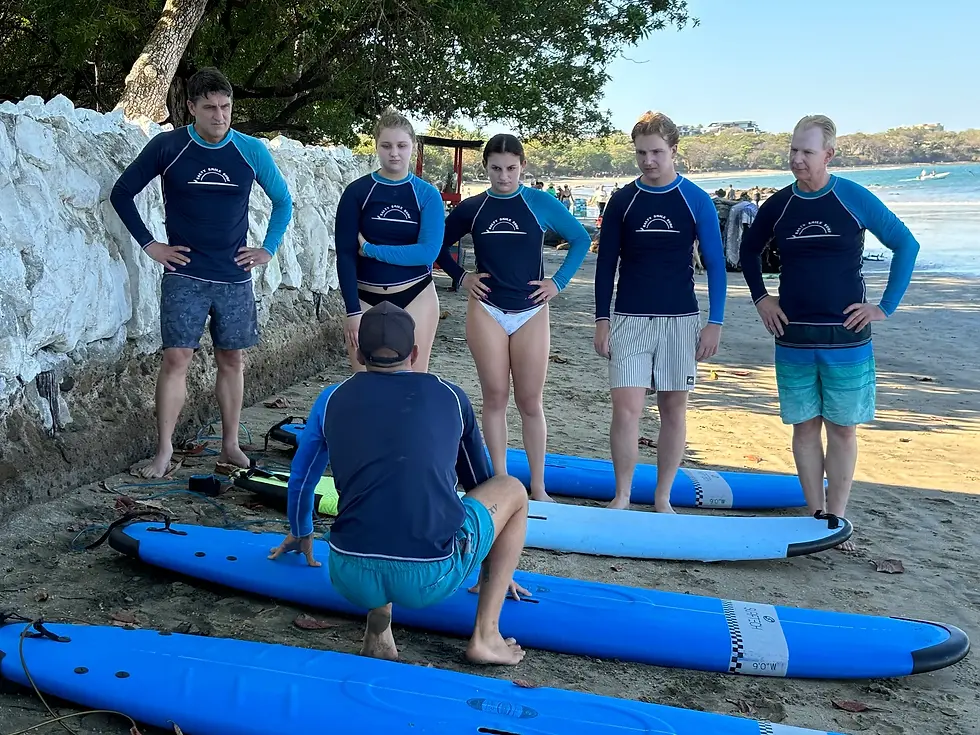
At Salty Smile Surf, soft-top surfboards and long-sleeve rash guards are provided for the lesson. Families also have access to lockers and a fresh-water shower at the surf school.
What Should You Tell the Surf School Beforehand?
The information you share before the lesson can be just as important as what you pack.
Let us know if your child:
- Is not a confident swimmer
- Is nervous or afraid of waves
- Has never spent much time in the ocean
- Has surfed before
- Has an injury, physical limitation, sensory need, or anything else that may affect the lesson
This isn't about deciding whether a child is “good at surfing” before they begin.
It helps the instructor understand how to approach the first session and what may help that child feel comfortable.
How Should You Prepare Your Child?
You don't need to teach them how to surf before the lesson.
In fact, keeping the explanation simple can be better.
Let them know they'll meet their instructor, learn a few things on the beach, practice with the board, and then enter the water when they're ready.
Try not to promise that they'll stand up on their first wave or tell them they have nothing to be afraid of.
Curiosity is enough.
For a complete step-by-step look at what happens during a child's first lesson, read our From Beach to Board guide.

Common Mistakes Families Make (And How to Avoid Them)
A family surf trip doesn't need much planning to be memorable, but a few common mistakes can make the experience harder than it needs to be.
Choosing a Lesson Based Only on Price
Price matters, especially when several family members want to surf.
But before comparing prices, make sure you're comparing the same type of experience.
Ask how many students will be with each instructor, whether your family will be mixed with other bookings, how long the lesson lasts, what equipment is included, and how the surf school chooses the lesson time and location.
At Salty Smile Surf, each booking stays private to your family or group. We don't add strangers to your lesson.
For beginners, we normally work with a maximum of two students per instructor, allowing the instructor to stay close and give each surfer personal feedback in the water.
Expecting Every Child to Progress the Same Way
One sibling may stand up quickly while another spends more time becoming comfortable in the ocean.
That doesn't mean one lesson is working and the other isn't.
Avoid comparing children by how many waves they catch or how quickly they stand up. Their confidence, coordination, previous ocean experience, and personality can all affect how they learn.
Planning Too Much Around the Surf Lesson
A surf lesson can already be one of the biggest activities of the day.
Packing another tour or physically demanding activity immediately before or after it can leave children tired before they've had time to enjoy the experience.
Leave some breathing room in the schedule.
Booking Every Lesson Before Seeing How the Kids Respond
If surfing is completely new to your children, you don't always need to decide in advance exactly how their entire week will unfold.
Some kids finish the first session wanting to surf every day. Others benefit from a rest day between lessons.
If your travel schedule allows it, leave enough flexibility to adjust based on their energy, confidence, and progress.
Focusing Only on Standing Up
Standing on the board is exciting, but it isn't the only sign that a child is learning.
Understanding basic ocean safety, listening to the instructor, getting comfortable with waves, improving body position, and becoming more independent are all part of learning to surf.
Sometimes the biggest progress isn't the wave everyone sees.
It's the child who was nervous at the beginning asking, “Can we go again tomorrow?”
What Should Parents Look for in a Family Surf School?
For families, choosing a surf school isn't only about finding someone who can teach the technique.
The instructor also needs to know how to communicate with children, recognize when a child needs encouragement and when they need more time, and explain what's happening clearly enough that parents feel comfortable too.
Before booking, it's worth asking:
- Will our family have its own instructors, or will we be combined with other guests?
- How many students does each instructor work with?
- How is the lesson time chosen?
- Does the lesson begin with ocean safety and beach instruction?
- Can the lesson be adapted if our children have different ages, confidence levels, or previous experience?
- What happens if the ocean conditions aren't appropriate for beginners?
The answers tell you much more than the lesson price alone.
What Bobby Looks for When Teaching Families
Bobby, co-owner of Salty Smile Surf School and one of our instructors, has spent years teaching beginners and families in Tamarindo.
When working with children, he doesn't expect every student to respond to the ocean in the same way.
Some kids need technical instruction right away.
Some need to understand what's happening before they feel comfortable.
Others simply need a little time to play with the board and build trust with their instructor.
The first job is to read the surfer in front of you.
From there, the coaching can become more technical as the child's confidence, ocean awareness, and skills develop.
For parents, that means the goal isn't to force a particular result from the first lesson.
It's to give each child the right starting point - and something they genuinely want to continue.
A Family's Experience
“Juan was an exceptional instructor-patient, encouraging, and fantastic with the kids.
He had them up on their boards and super confident in no time.”
Brad Blaze - Google Review ★★★★★
Brad's family was already planning to return for another lesson the following day - exactly the kind of outcome we hope for with a child's first surf experience: not simply standing on the board, but leaving the water excited to surf again.
A Great Family Surf Vacation Isn't About Perfect Waves
Years from now, your children may not remember exactly how many waves they caught or which day they first stood up.
They may remember the instructor who made them laugh when they were nervous.
They may remember watching a parent fall off a surfboard, cheering for a sibling's first ride, or walking back up the beach asking when they could do it again.
That's what a family surf vacation can become when there's enough structure to feel supported - and enough flexibility to let each person experience surfing in their own way.
You don't need to plan every lesson, activity, and hour before arriving in Tamarindo.
Start with the people in your family.
Consider their ages, swimming ability, ocean confidence, previous experience, and how much time you actually want to spend surfing. Then let the daily conditions help shape the rest.
The goal isn't to create the perfect surf schedule.
It's to create the kind of family experience you'll still talk about after the vacation is over.
Ready to Plan Your Family Surf Vacation in Tamarindo?
If you're considering surf lessons for your family, we're happy to help you figure out what makes sense for your children, your experience levels, and the time you have in Tamarindo.
At Salty Smile Surf School, your family or group stays private to your booking, and beginner lessons are normally organized with a maximum of two students per instructor.
Lesson times are selected around the conditions and the surfers in your group, so you don't need to know the perfect tide or schedule before contacting us.
Tell us who's traveling, the ages of your children, whether anyone has surfed before, and how many days you'll be in Tamarindo.
From there, we can help you build a surf experience that fits naturally into the rest of your vacation.
Family Surf Vacation in Tamarindo: Frequently Asked Questions
What age can kids start learning to surf in Tamarindo?
There isn't one perfect age for every child.
Age matters, but swimming ability, ocean confidence, comfort with an instructor, and willingness to try are just as important. With younger children, the first goal may simply be building trust and having a positive experience in the water.
Do kids need to be strong swimmers to take a surf lesson?
Parents should always tell the surf school honestly about their child's swimming ability and comfort in the ocean before the lesson.
This helps the instructor choose the right approach, level of support, and conditions for that child.
Will our family be mixed with other people during the lesson?
At Salty Smile Surf School, your family or group stays private to your booking.
We don't add strangers to your lesson.
For beginners, we normally work with a maximum of two students per instructor so the instructor can stay close and provide personal guidance.
What is the best time of day for a family surf lesson in Tamarindo?
There isn't one time that is best every day.
The ideal lesson window can change with the tide, swell, wind, wave size, and the experience of the surfers.
We recommend lesson times based on the conditions and the people in your booking rather than automatically choosing morning or afternoon.
How many surf lessons should a family book?
It depends on your goals and how each family member responds to the first session.
One lesson can be a great introduction, while several lessons allow beginners to build confidence, improve technique, and gradually become more independent. If surfing is completely new to your children, their first lesson can also help you decide how much surfing makes sense for the rest of the trip.
What should we bring to a family surf lesson?
Bring reef-safe sunscreen, drinking water, a towel, dry clothes, and a small snack if needed. Salty Smile Surf provides soft-top surfboards and long-sleeve rash guards, as well as access to lockers and a fresh-water shower.
Keep your smile salty.


Comments